
 Get Support
 admin
Ask your finance team a simple question: what does our manual HR actually cost us in a year? They can tell you HR salaries. They can tell you the software quote sitting in someone’s inbox. But the cost of reconciling attendance by hand, correcting payroll errors, and the PF deposit that slipped last March? That number lives nowhere.
This is the trap in the whole “should we automate?” conversation. Manual HR is not free. It is just unbilled. Its costs are real and recurring, but they arrive in small pieces across twelve months and three departments, so nobody adds them up. Automation, meanwhile, shows up as one clean, obvious invoice. The two are rarely compared fairly.
Here’s a straight, numbers-first comparison of manual HR versus automated HR — the true cost of each, the risks on both sides, a simple way to calculate your own ROI, and an honest answer to the question most vendors avoid: when is staying manual actually the smarter call?
IN SHORT
HR automation uses connected software to run HR tasks — attendance, payroll, leave, compliance, and self-service — on one shared employee record with no manual re-entry. Manual HR handles the same tasks by hand across registers, spreadsheets, and email.
Automation costs more upfront but less per employee as you grow; manual HR looks
cheaper but carries hidden costs in labour, error correction, and compliance penalties. The right choice depends on your headcount, hiring pace, and statutory load — most Indian businesses cross the point where automation pays for itself between roughly 25 and 50 employees.
SUMMARY: KEY POINTS
- Manual HR looks cheaper because its costs are hidden inside salaries, corrections, and one-off penalties — not because it is cheaper.
- Automating admin HR tasks returns 7+ hours per week per person (SHRM); nearly half of HR teams lose 5+ hours a month just fixing errors.
- In India, a single late PF/ESI deposit can cost more than a year of software once you add interest, damages, and the lost tax deduction.
- Automation’s real cost is more than the licence — implementation, data migration, change management, and ownership all count.
- The semi-automated middle (disconnected tools bridged by spreadsheets) is often the most expensive place to be.
- Automate payroll and attendance first — highest volume, highest risk, fastest
- Manual HR still wins for very small, stable, low-compliance teams. Know your crossover point.
Why This Comparison Is Trending in 2026
HR automation isn’t new, so why is “automate or stay manual” suddenly a board-level question? A few forces converged.
- The Labour Codes raised the cost of getting it wrong: India’s four Labour Codes consolidate 29 central laws and change how wages, contributions, and records must be handled. Manual compliance across a shifting rulebook is exactly where errors breed.
- DPDP made employee data a legal liability: Under the Digital Personal Data Protection Rules, 2025, employee records are regulated personal data — a filing cabinet and a shared spreadsheet are hard to defend under that standard.
- The tools got genuinely: Automation used to mean digitising forms. Now it means anomaly detection, self-service assistants, and analytics at a price small businesses can afford.
- Cost pressure sharpened every question: With “do more with less” now the default mandate, every recurring inefficiency is under scrutiny — and manual HR is a large, quiet one.
There’s a human angle too. Recent studies show HR professionals spend up to 57% of their time on administrative tasks. That’s more than half of a trained professional’s week on work that doesn’t need their training.
First, What Do “Manual” and “Automated” Actually Mean?
Almost no company is fully one or the other. Most sit somewhere in the middle — and the middle is often the costliest spot of all. Think of it as three stages.
| Stage | What it means | What it looks like in HR |
| Manual | People move information by hand between tools. | Attendance in a register, salary in Excel, leave over email, records in a cabinet. |
| Semi-automated | Tools exist but don’t talk to each other; people bridge the gaps. | A payroll tool and a separate attendance app, reconciled by exporting and re- importing spreadsheets every month. |
| Automated | Information flows between functions on one system, with no re-entry. | Attendance feeds leave feeds payroll feeds compliance — one employee record, no re- keying. |
The True Cost of Manual HR (The Hidden Bill)
Manual HR costs sit in three layers. Most companies only ever see the first — and it’s the smallest.
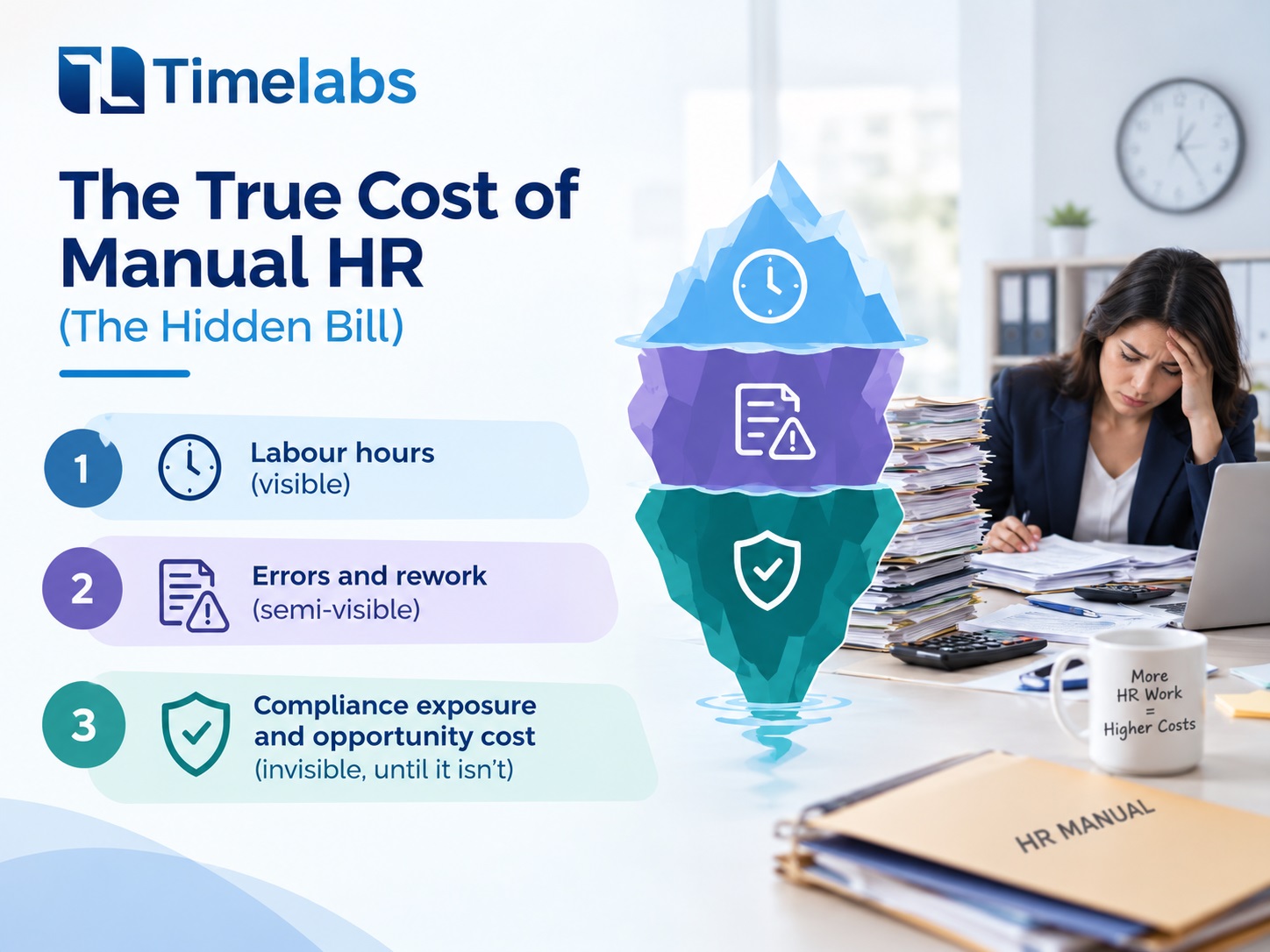
Layer 1: Labour hours (visible)
The benchmarks are consistent. SHRM found that automating administrative HR tasks frees more than seven hours per week per HR person. Payroll administrators alone spend 3–8 hours per cycle on manual data entry before any corrections. Collecting and reconciling attendance for an hourly workforce can eat 45–60 minutes every single day.
Layer 2: Errors and rework (semi-visible)
Manual processes generate errors, and errors cost more time — plus something you can’t easily price: trust. Remote’s State of Payroll research found 49% of HR teams spend 5+ hours a month just correcting mistakes. EY’s cost work puts a single manual HR data entry at around $4.86, with complex tasks like benefits enrolment near $89 per employee.
Layer 3: Compliance exposure and opportunity cost (invisible, until it isn’t)
This is the layer that turns a small slip into a real financial event — and in India it’s sharp. Manual tracking of monthly statutory deadlines is exactly where things get missed, and Indian penalties are built to punish delay.
| Obligation | What a delay costs | Why manual makes it worse |
| Provident Fund | 12% p.a. interest under Section 7Q, plus damages under Section 14B graded from 5% (under 2 months) to 25% (over 6 months) per year. Damages are on top of interest, not instead. | The 15th-of-month deadline is unforgiving; if it lands on a holiday, payment is due the preceding working day. |
| ESI | 12% p.a. interest on the outstanding amount, plus graded damages and, for continuing default, prosecution under Section 85. | Calculating ESI on basic instead of gross wages is a classic manual error; the shortfall is treated as a delay for each month. |
| TDS on salary | Interest of 1% per month for non-deduction and 1.5% per month for non-deposit after deduction, plus possible penalty. | Manual TDS maths across variable pay and investment declarations is error-prone at the worst moments. |
| The deduction trap | Under Section 36(1)(va), the employee’s PF/ESI share is deductible only if deposited by the due date. Deposit late and you permanently lose the deduction — confirmed by the Supreme Court in 2022. | A single late deposit doesn’t just attract interest; it converts a deductible expense into taxable income. |
Government data cited across compliance guides suggests more than 60% of labour-law violations in India relate to late or non-payment of PF and ESI — the precise failure mode manual tracking produces.
The last part of this layer is opportunity cost — the retention work, workforce planning, and employee experience that never happen because the team is buried in admin. It never shows up as a loss, because you don’t see the value you didn’t create. But it compounds, and it’s often the most expensive line of all.
The Honest Cost of Automation
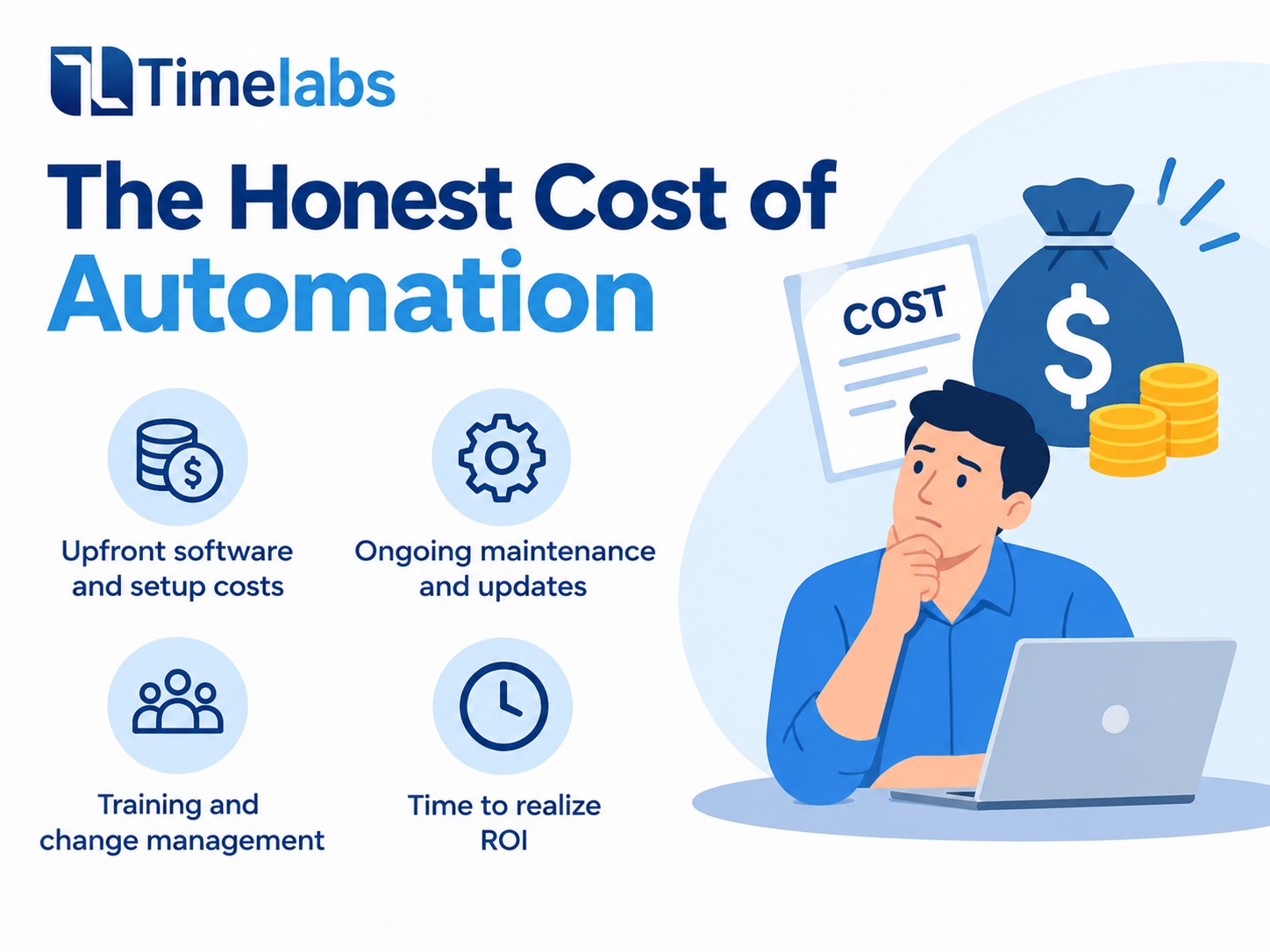
A fair comparison cuts both ways. If we’re exposing the hidden costs of manual HR, we have to be equally honest about what vendors understate. The licence is the number everyone quotes — and rarely the one that matters most.
| Cost | What to budget for |
| Licence/subscription | The visible per-employee fee. Usually the smallest lifetime cost. Watch for module-by-module pricing that only covers part of what you need. |
| Implementation & setup | Configuring your pay structure, leave policies, shift rules, and statutory setup. Often a one-time fee that can rival year-one licence. |
| Data migration | Moving employee master data and balances in. The messier your current data, the bigger this is — and manual-era data is usually messy. |
| Change management | Training, communication, and the productivity dip while people learn. The most understated cost and the biggest predictor of failure. |
| Ongoing ownership | Someone must own the system. Automation reduces work; it doesn’t remove the need for an owner. Unowned systems decay. |
Manual vs Automated HR: Side by Side
| Dimension | Manual HR | Automated HR |
| Speed | Payroll takes days; corrections add cycles. | Runs compress to hours; errors caught before disbursement. |
| Error rate | Rises with volume; every re-entry adds risk. | Structurally lower; validation catches errors at entry. |
| Compliance | Depends on individual memory; high exposure. | Deadlines and rule changes tracked; alerts before due dates. |
| Scalability | Cost rises with headcount — more people, more hours. | Marginal cost per new employee is low; scales cleanly. |
| Cost trajectory | Looks low, grows silently forever. | High upfront, then flattens; cost per employee falls as you grow. |
| Auditability | “Who changed what, when” is slow or impossible. | Every change logged; audit- and DPDP-ready. |
| Employee experience | Queries wait for HR; payslips on request. | Self-service, instant answers, mobile access. |
| Key-person risk | Process lives in one person’s head; they leave, it breaks. | Process lives in the system; survives turnover. |
| Best suited to | Very small, stable, single-location teams. | Growing, multi-location, or compliance-heavy organisations. |
Read the cost trajectory row twice — it’s the crux. Manual HR is genuinely cheaper at very small scale and quietly more expensive with every hire. Automation costs more to start and less per employee as you grow. The real question isn’t “which is cheaper?” It’s “where’s our crossover point, and are we past it?”
How to Calculate Your HR Automation ROI
You don’t need a consultant for this. Five steps, your own numbers.
- Cost your HR: Loaded annual cost per HR person ÷ productive hours per year = cost per hour.
- Count reclaimable: Estimate weekly hours on data entry, reconciliation, query answering, and report building. Be conservative.
- Add rework and Error-correction hours, plus a realistic annual figure for compliance exposure (even one avoided late deposit has real value).
- Total the automation Licence + amortised implementation + change management + ownership.
- Find Annual benefit ÷ net first-year cost. Under 18 months is generally a clear yes; over 36 months warrants a harder look.
A QUICK WORKED EXAMPLE
A 300-employee company, HR team of three, loaded cost ~₹380/hour. Reclaimed admin time (7 hrs/week × 3 people × ~47 weeks) ≈ ₹3.76 lakh/year. Add ~₹23,000 in error- correction time and just one avoided late PF deposit (interest, damages, and lost Section 36(1)(va) deduction can total ₹1.5–2 lakh). Set that against a realistic all-in year-one cost, and payback often lands under a year. Figures are illustrative — swap in your own.
Notice what did the heavy lifting: not the software’s cleverness, but the compliance layer. For compliance-heavy Indian organisations, the strongest ROI argument is usually risk avoided, not hours saved. For a low-risk, low-complexity business, the same maths can push payback past three years — which is a perfectly good reason to wait.
Risks on Both Sides
Staying manual isn’t “safe,” and automating isn’t “done.” Each carries failure modes.
Risks of staying manual:
- Compliance drift: the biggest one; missed statutory deadlines compound
- Key-person dependency: the process lives in one person’s spreadsheets; their exit is a crisis.
- Silent scaling cost: manual cost grows with headcount without ever triggering a budget review.
- Data-protection exposure: spreadsheets and email are hard to secure or account for under DPDP.
Risks of automating badly:
- Shelf-ware: paying for a system nobody adopts because change management was
- Garbage in, garbage out: automating on messy master data just industrialises the
- The half-migration: new system live, old spreadsheets still running “just in case,” paying for both.
The pattern: the risks of staying manual are passive and compounding; the risks of automating are active and avoidable with planning.
What to Automate First
You don’t automate HR in one move — you sequence it. Order modules by highest pain, highest volume, highest compliance risk, lowest change difficulty.
| Priority | Automate | Why it usually comes first |
| 1st | Attendance & payroll (with statutory compliance) | Highest volume, highest compliance risk, clearest error cost. Where manual HR bleeds most, so it pays back fastest. |
| 2nd | Leave management & employee self-service | Removes the biggest share of routine queries and gives employees instant transparency. High satisfaction, low risk. |
| 3rd | Onboarding & document management | Fixes the messy joining process and builds a clean, DPDP-ready record from day one. |
| 4th | Performance & analytics | Higher value, but depends on the earlier layers producing clean data first. |
TIMELABS HELPS
Timelabs runs this sequence on one connected platform — Time, Attendance & Leave and Payroll & Compensation for the high-volume layer, Employee Self-Service to cut routine queries, and HR Analytics for the decision data manual processes never surface.
When Manual HR Still Wins
Most articles on this topic won’t tell you this, because most are written to sell software. The honest version: sometimes manual HR is the correct, cheaper choice, and automating anyway is the mistake. Stay manual, at least for now, if most of these are true:
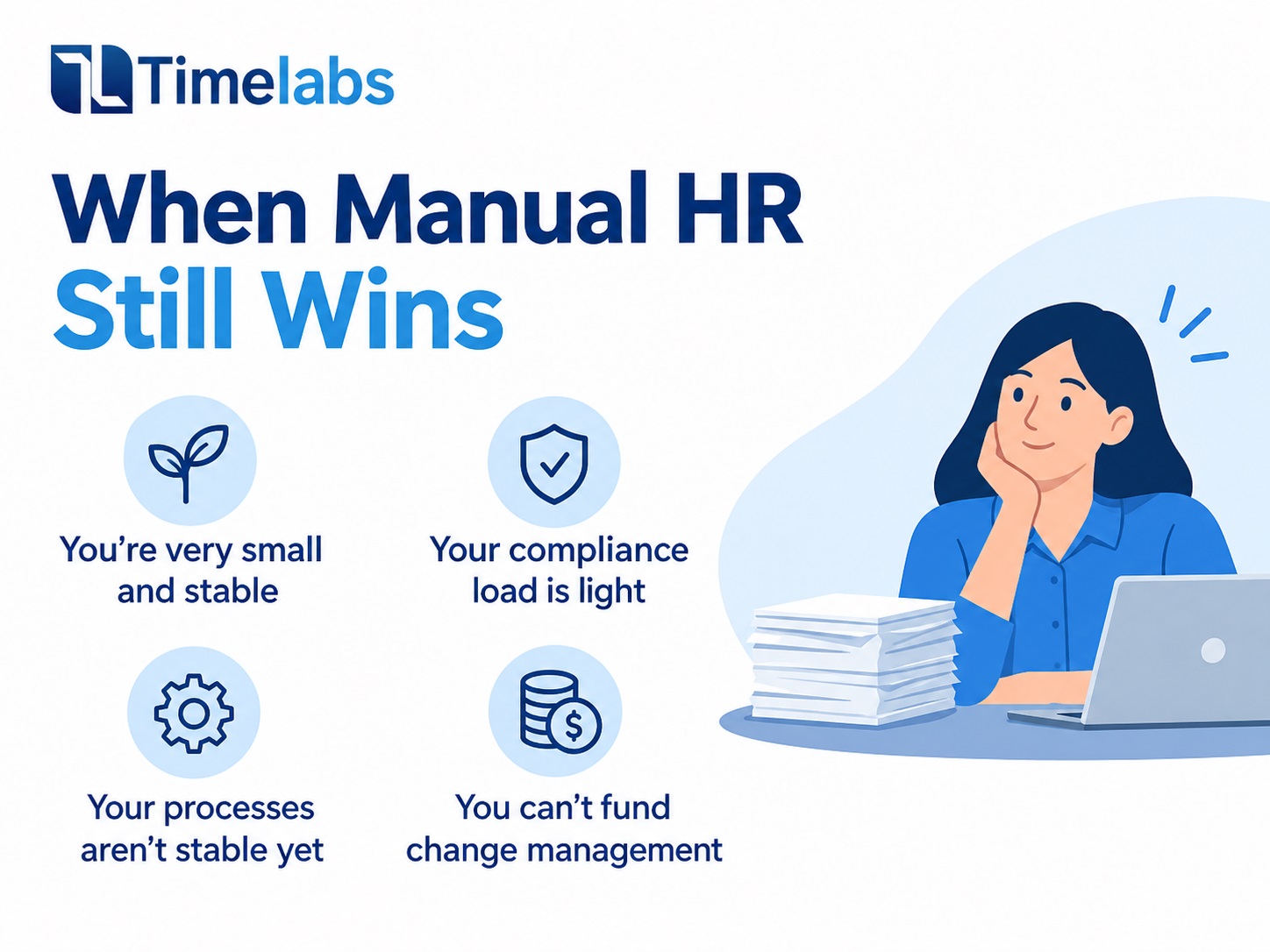
- You’re very small and stable: under ~20–25 employees, single location, low hiring, simple pay. Your crossover point is still ahead of you.
- Your compliance load is light: below the thresholds that trigger PF, ESI, and heavier obligations, the compliance layer that usually justifies the spend is small.
- Your processes aren’t stable yet: if policies change month to month, automating now means constant reconfiguration. Stabilise first.
- You can’t fund change management: if you genuinely can’t give the team time to adopt, buying now guarantees shelf-ware.
HR Action Checklist
| Action item | Owner |
| Calculate your loaded HR cost per hour and estimate weekly hours on data entry, reconciliation, and queries | HR / Finance |
| Log this month’s payroll corrections and the time they took | Payroll |
| Price your compliance exposure: list monthly statutory deadlines and the cost of one realistic late deposit | HR / Compliance |
| Total your three-layer manual cost — the number finance has never seen | HR / Finance |
| Get one or two real quotes and build the honest all-in automation cost | HR |
| Run the five-step ROI model; calculate payback and your crossover point | HR / Finance |
| If automating, pick the first module (usually payroll + attendance) and name an owner | HR |
| Clean the employee master data before migration, not after | Payroll / HRMS Admin |
| If staying manual, set the trigger (headcount, new location, threshold) to re- run the model | HR |
Must Read: HR Analytics in India: How CHROs Use Data to Cut Attrition by 30%
Frequently Asked Questions (FAQs)
Q1: Is HR automation cheaper than manual HR?
A: It depends on scale and compliance load. Manual HR is cheaper at very small, stable sizes. As you add employees, locations, or statutory obligations, the total cost of manual HR — labour, error correction, and compliance exposure — usually overtakes automation.
Compare total cost to total cost, not the software quote to zero.
Q2: What is the ROI of HR automation?
A: ROI comes from three sources: reclaimed labour hours (SHRM found 7+ per week per HR person), reduced error correction (nearly half of HR teams lose 5+ hours a month), and avoided compliance penalties. For compliance-heavy Indian organisations, the avoided-
penalty layer is often the largest driver. Payback under 18 months is generally a clear yes.
Q3: How do I calculate the cost of my manual HR?
A: Add three layers: (1) HR hours on admin × loaded hourly cost; (2) error-correction hours plus the trust cost of pay mistakes; (3) compliance exposure plus opportunity cost. Most companies only count Layer 1, which is why manual HR looks deceptively cheap.
Q4: What does a late PF or ESI payment actually cost in India?
A: More than most expect. Late PF attracts 12% annual interest (Section 7Q) plus 5–25% damages (Section 14B); ESI attracts 12% interest plus graded damages. Critically, under
Section 36(1)(va), the employee’s contribution share loses its tax deduction if deposited late
— confirmed by the Supreme Court in 2022 — which can be the largest cost of all.
Q5: Will automating HR mean job cuts?
A: The evidence points to redeployment, not replacement. Automation absorbs administrative hours and shifts HR toward work that needs judgement — retention, planning, employee experience. Research consistently shows responsibilities shifting far more often than roles being displaced.
Q6: Is my company too small to automate HR?
A: Size determines which use case pays back, not whether automation is possible. Very small, stable, single-location teams below statutory thresholds are often better off manual for now. But a company hiring fast should model payback at its target size — the crossover often arrives sooner than expected.
Q7: What should I automate first?
A: Attendance and payroll with statutory compliance, in almost every case. They combine the highest volume, highest cost of error, and clearest measure of success, so they pay back fastest. Then leave and self-service, then onboarding, then performance and analytics.
Q8: Why do HR automation projects fail?
A: Usually not because of the software. The common failures are underfunded change management (non-adoption), migrating dirty data, automating a broken process, doing everything at once, and having no named owner. Each is avoidable with planning.
Q9: Is semi-automated HR a good middle ground?
A: Often it’s the most expensive place to be. Running separate tools bridged by manual
spreadsheet exports means paying for the tools, paying people to move data between them, and absorbing the errors every bridge creates. Connected beats fragmented.
Q10: Does automation guarantee compliance?
A: No. It dramatically reduces the risk of missed deadlines and calculation errors and creates the audit trail regulators and DPDP require — but it doesn’t transfer legal liability or replace advice on genuinely ambiguous rules. Treat it as a strong monitoring layer, not a lawyer.
Q11: How do I measure whether automation worked?
A: Record a baseline before you start — hours on admin, corrections per cycle, compliance events — then compare. Focus on outcome metrics (days to run payroll, tickets per 100
employees, corrections per cycle), not activity metrics like “records processed,” which rise automatically and prove nothing.
Q12: Should I trust a vendor’s ROI calculator?
A: Build your own instead. Vendor calculators optimise for a fast yes and rarely include the honest cost side — implementation, change management, ownership. A five-step model with your own numbers takes an afternoon and lets you evaluate any quote, including the option to wait.