 Get Support
 admin
Walk into almost any leadership meeting in India, and you’ll hear it within the hour. We need HR to be more strategic. It sits on every offsite agenda, in every CHRO’s mandate, in the brief for every senior people hire. Yet if you quietly followed most HR teams through an ordinary week, you’d struggle to find much strategy. You’d mostly find firefighting.
That isn’t a criticism of the people doing the work. It’s a description of the trap they’re in. Survey after survey lands on the same uncomfortable number: most HR teams spend the bulk of their time on administration, not strategy. A widely cited BambooHR study found that six in ten business leaders think HR spends more time on paperwork and maintenance than on anything strategic. Deloitte estimates that well over half of HR time is lost to administrative work. The intent to be strategic is there. The room to act on it usually isn’t.
So the interesting question was never whether Indian companies should move from reactive to strategic HR. Everyone already agrees they should. The real question is how you make that journey, because that is exactly where it stalls, year after year, in company after company.
This is a roadmap for actually making it. Not a whiteboard version, but one written for the messy, compliance-heavy, fast-moving reality of running a business in India.
How Indian HR Got Stuck in Reactive Mode
To fix the problem, it helps to understand how we got here, because reactive HR wasn’t a mistake. For a long time, it was the sensible response to the conditions Indian businesses operated in.
Human resources in most Indian companies grew out of the old “personnel department.” Its job was clear and narrow: hire people, mark attendance, disburse salaries, and keep the statutory paperwork in order. That last part was never trivial. Indian labour law is genuinely dense and unforgiving, with provident fund, ESI, professional tax, gratuity and a thicket of state-specific rules all carrying real penalties for getting it wrong. So HR learned, very rationally, to be careful, procedural and backwards-looking. The whole function was optimized around one goal: don’t get it wrong.
Everything else followed from that. HR became the department you called when something broke. A resignation landed. A dispute flared up. An audit loomed. In between those fires, the days filled with the quiet, relentless grind of administration, the forms, the registers, the reconciliations. Research from the Centre for Effective Organizations found HR professionals spending nearly three-quarters of their time on exactly this kind of routine work.
None of this was laziness or lack of ambition. It was a function doing precisely what it had been built and rewarded to do. The trouble is that the world around it changed, and the model didn’t.
Consider what an Indian business now has to navigate. A workforce that’s increasingly hybrid and distributed, with well over half of white-collar staff working outside a traditional office. A genuine war for skilled talent, where attrition in some sectors still runs to a quarter of the workforce a year. A wave of regulatory change, from the new labour codes to the DPDP Act, that rewrites payroll and data obligations. And a leadership team that, quite reasonably, wants HR to help it plan for all of this rather than simply react once it happens.
A function built to avoid mistakes cannot meet that brief. Reactive HR made sense in a slower, more predictable era. Today it’s a quiet liability, and most leaders can feel it even when they can’t quite name it.
Must Read: DPDP Act 2023 and HR Data: What HR Teams Must Fix Before It’s Too Late
What “Strategic HR” Actually Means
Before the roadmap, it’s worth cutting the phrase down to size, because “Strategic HR” has been inflated into something vague and slightly intimidating. It doesn’t mean fancy dashboards, a fashionable job title, or a consultant’s framework on the wall.
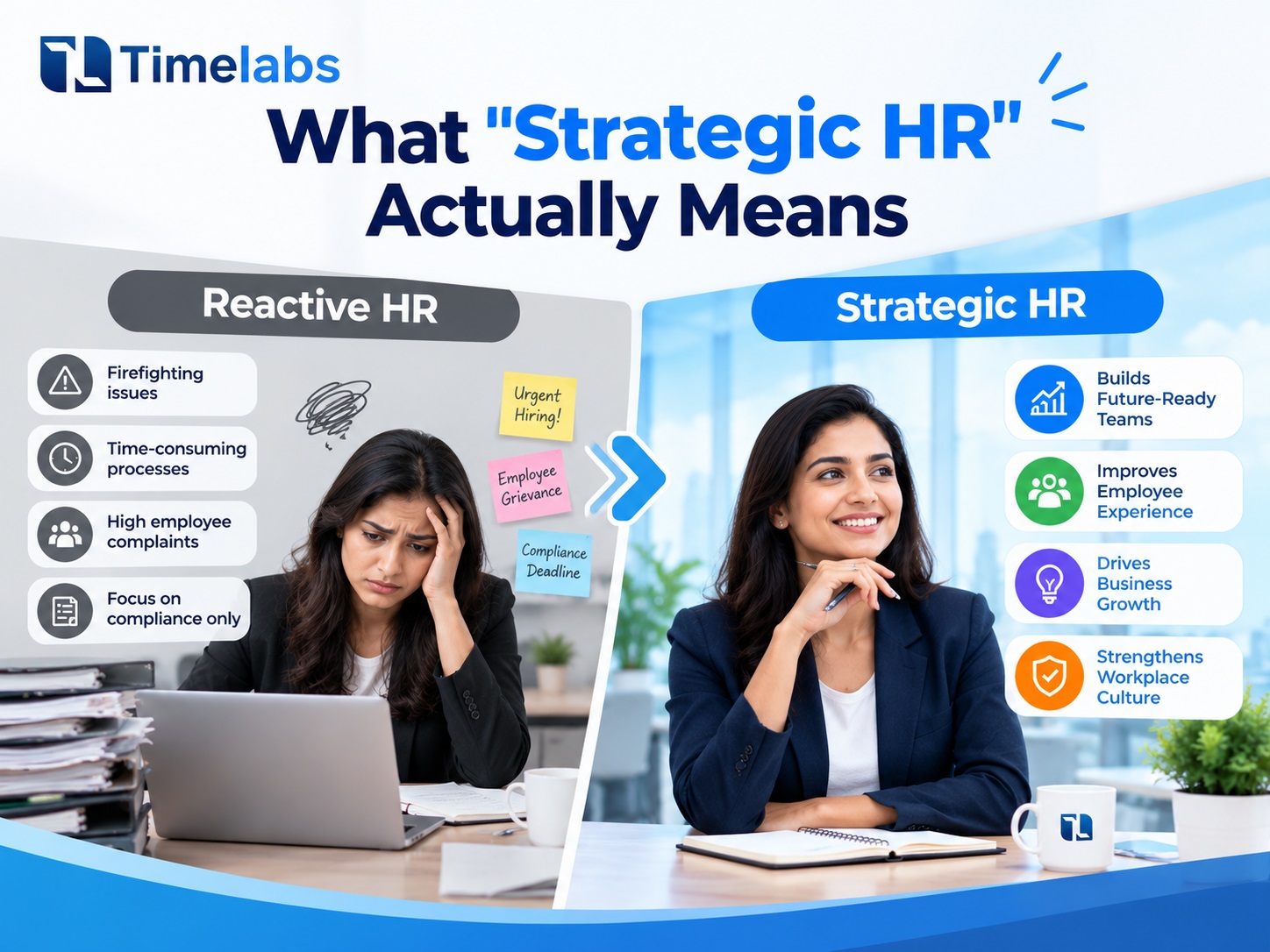
Strategic HR simply means an HR function that shapes business outcomes ahead of time rather than cleaning up after them. That’s the whole idea. Everything else is detail. The difference shows up most clearly when you put the two postures side by side.
Reactive HR:
• Scrambles to backfill the day a good person resigns
• Opens a role only once a seat falls empty
• Firefights compliance before an audit or deadline
• Brings opinions to the meeting.
• Looks backwards and responds
Strategic HR:
• Sees attrition risk building months earlier and acts
• Plans the workforce against where the business is going
• Runs compliance quietly in the background, correct by default
• Brings evidence to the meeting
• Looks forward and shapes
Notice the common thread. It isn’t sophistication. It’s time horizon and posture. Reactive HR looks backwards and responds. Strategic HR looks forward and shapes. One is a fire brigade, rushing to whatever is burning. The other is closer to urban planning, designing things so fewer fires start in the first place.
And here’s the part that trips people up. Becoming strategic doesn’t mean abandoning the operational work. Payroll still has to run. Attendance still has to be captured. Compliance still has to be watertight. The shift is about automating that groundwork so reliably that HR finally has the time and the clean data to think ahead. You don’t earn a seat at the strategy table by ignoring the basics. You earn it by getting the basics off your desk.
The Roadmap: Four Rungs From Reactive to Strategic HR
Here is the most useful way I’ve found to think about the journey. HR doesn’t flip from reactive to strategic overnight. It climbs, one rung at a time, through four recognisable stages of maturity. Every function is standing on one of these rungs right now, and the point of a roadmap is simply to help you find the next one.
It’s the same path the finance function walked years ago, from basic bookkeeping to a CFO shaping company strategy. HR is making the same climb, just a decade or two later.
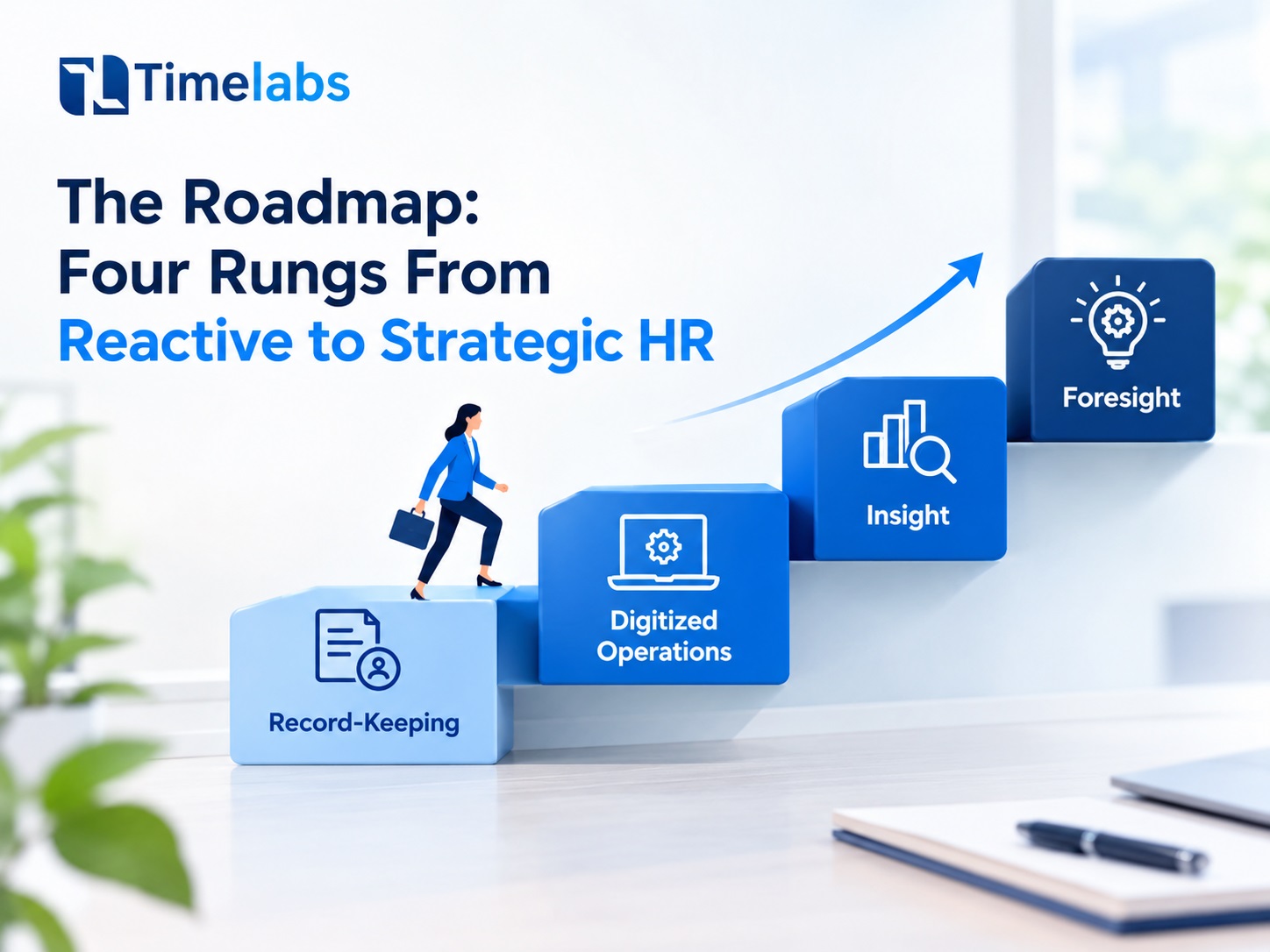
1. Record-Keeping
This is the ground floor, and it’s where a surprising number of Indian companies still live. People data sits in a filing cabinet, a stack of registers, and a sprawl of spreadsheets that only one or two people fully understand. Payroll is a monthly ordeal. Answering a simple question, like how many people left the sales team last year and why, takes days of manual digging, if it can be answered at all.
The tell that you’re stuck here is that HR spends its energy just keeping records straight, and every report is a fresh archaeological dig. Research on the Indian HRMS market is blunt about how common this remains: while large corporations have invested, a great many small and mid-sized businesses still run on manual or semi-automated processes, held back by tight budgets, low awareness, and a very human resistance to change, especially in family- run firms.
What unlocks the next rung is unglamorous but decisive: getting your core people data out of scattered files and into a single system of record. This is what an HRIS in India is for. Not analytics, not AI, just one reliable place where employee records, payroll, attendance, and leave actually live together.
2. Digitized Operations
Now you have a system. An HRIS or HRMS holds your records, payroll runs on rails, attendance and leave are captured digitally, and employees can serve themselves from an app instead of emailing HR for a payslip. Crucially, you can now answer the question “what happened?” without a week of effort.
This is real progress, and it’s where much of India’s HR-tech growth is happening. The market crossed the one-billion-dollar mark in 2025, with adoption spreading well beyond the metros into Tier-2 and Tier-3 cities. But it’s also where a lot of transformations quietly stop.
The trap on rung two is mistaking digitization for transformation. You’ve automated the paperwork, which is genuinely valuable, but your reports still only look backwards. HR is faster now, yet still fundamentally reactive, producing tidy monthly summaries that describe the past and change nothing about the future. Worse, some companies digitize their chaos, taking messy, inconsistent processes and simply running them faster.
What unlocks rung three is a shift in habit more than a shift in tools: connecting the data you’re now collecting and starting to ask, relentlessly, not just what happened but why.
3. Insight
On this rung, the data starts talking. Your systems are connected, so attendance, payroll, performance and exit information can finally be looked at together. You move from description to diagnosis and then to prediction. Which teams are quietly bleeding people, and what do those leavers have in common? Which new hires are most at risk in their first year? This is the territory of HR analytics software in India, and it’s where HR stops merely reporting and starts genuinely influencing decisions.
The tell that you’ve reached rung three is that a number occasionally changes what the business does, a manager gets coached, a pay band gets corrected, a hiring plan gets rethought, because the data pointed at a problem before it became a crisis.
The trap here is subtler and very common: analysis that never becomes action. Beautiful dashboards get built and admired, and then nothing happens. Insight that doesn’t hand off to a decision is just expensive decoration.
What unlocks the final rung is tying that insight directly to the choices leadership is already making, and earning the right to be in the room when those choices are shaped rather than after.
4. Foresight
This is strategic HR in its full sense, and it’s rare, which is worth saying plainly so nobody feels behind. On rung four, HR helps set direction rather than support it. Workforce planning is tied to the business plan. Leaders can ask “if we enter this market or grow this division, what talent will we need, when, and what will it cost?” and get a real answer. Scenarios get modelled. Skills gaps get anticipated years out. Compliance and risk are managed proactively, not scrambled after the fact. HR has a genuine seat at the strategy table because it’s earned one, by consistently seeing round corners.
The Three Shifts That Matter More Than The Software
It’s tempting to read a roadmap like this as a shopping list, buy the right platform and you’re strategic. That’s the most expensive mistake in the whole exercise. Digital HR transformation in India fails far more often from neglecting the human and organizational shifts rather than from picking the wrong software. Three shifts matter more than any tool.
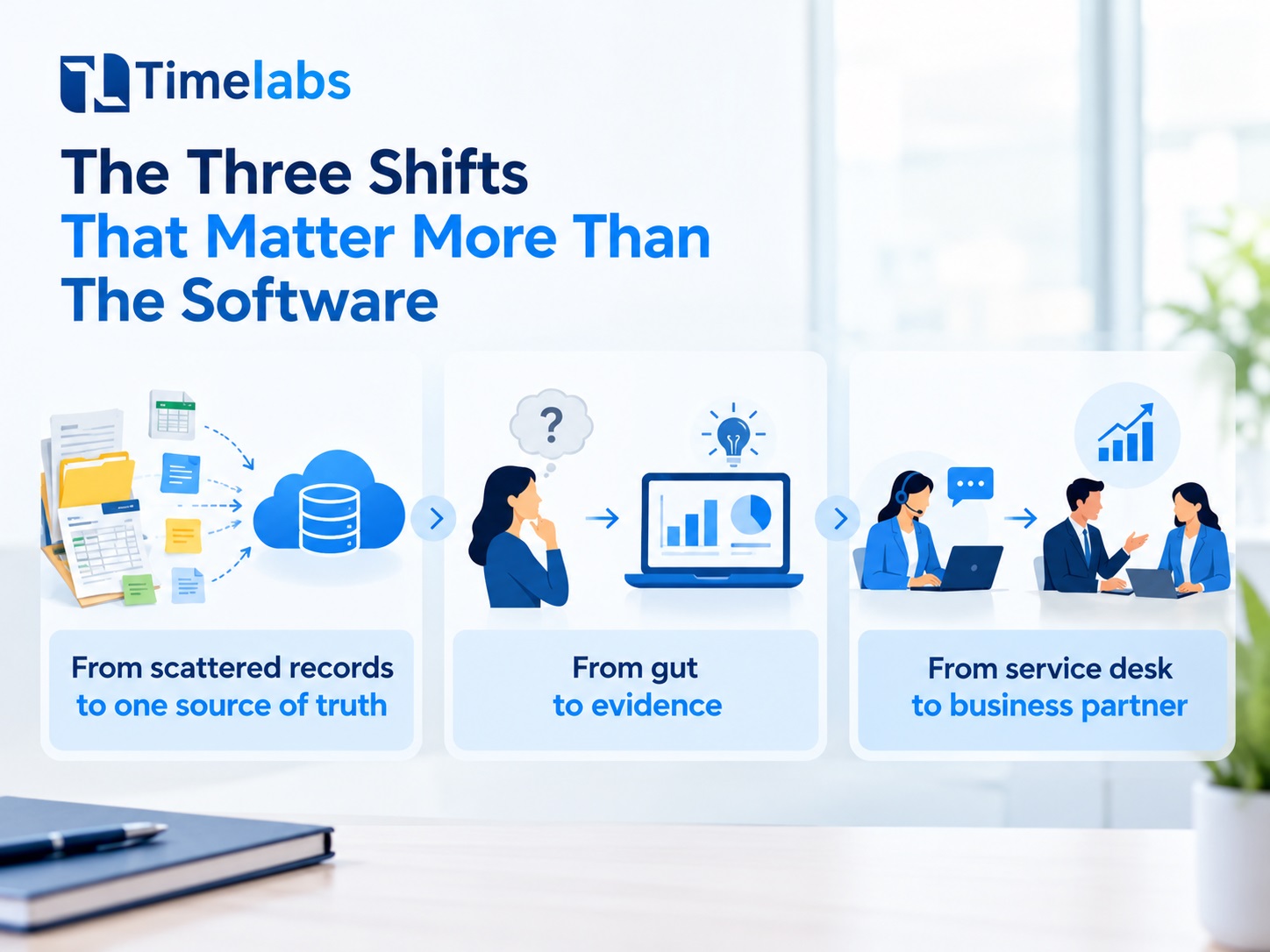
From scattered records to one source of truth: You cannot be strategic on data that lives in five disconnected silos. The foundation of everything above is a single, trustworthy system where attendance, payroll, performance and compliance actually meet. This is the least glamorous shift and the most important, because every rung after it depends on the data being clean, connected and current. It’s precisely the gap a modern HRMS built for Indian conditions is meant to close, and it’s where a platform like Timelabs is designed to sit, unifying the messy operational data most companies keep in separate places.
From gut to evidence: Tools don’t create a data-driven culture; leaders do. The habit that actually moves a company up the ladder is a simple, repeated question in every meeting: what does the data say? When that question becomes reflexive, analytics stops being a project the software team runs and becomes the way decisions are made. No amount of HR analytics software in India will help a company that still decides by seniority and instinct.
From service desk to business partner: This is the operating-model shift, and it’s the hardest. It means automating the high-volume admin so aggressively that HR has room to think, then changing what HR is actually measured on, from tickets closed to business outcomes influenced. It also means new skills, because reading workforce data and advising leaders is a different craft from processing paperwork. The direction of travel is already clear: roughly a third of Indian employers say they plan to automate administrative HR roles, not to cut HR, but to free it from what people rightly call the “admin trap.”
Where Digital HR Transformation Goes Wrong in India
Plenty of transformations start with genuine intent and still fizzle. The failure modes are predictable, and knowing them is half the battle.
The most common is buying tools before fixing the process. Software poured over a broken process just gives you a faster broken process. Map and tidy the workflow first, then automate it.
The second is treating this as an IT project rather than a people project. The evidence here is striking: most HRMS rollouts that fail don’t fail because the software was bad. They fail on adoption, because the change was over-standardised, poorly communicated, or forced on people who then quietly went back to their trusted Excel sheets. Transformation is change management with a technology component, not the other way around.
The third, and a distinctly Indian one, is ignoring the deskless and field reality. A huge share of the Indian workforce doesn’t sit at a desk; they’re on shop floors, in the field, moving between sites. A system designed only for office staff will capture attendance and productivity for a fraction of your people and leave the rest in the dark. Whatever you choose has to work for a supervisor on a phone in a warehouse as well as an analyst on a laptop.
The fourth is treating compliance as an afterthought. With the new labour codes reshaping wage definitions and PF liabilities, and the DPDP Act raising the bar on employee data, compliance can no longer be a manual scramble bolted on at the end. As one industry commentary put it bluntly, you simply cannot manage this complexity on a spreadsheet anymore. It has to be built into the system from the start.
The last is big-bang thinking. Trying to transform everything at once produces change fatigue and stalled projects. The companies that succeed move one rung at a time, prove the value, and build momentum.
Where to Start: A Pragmatic First Step
If all of this feels like a lot, here’s the reassuring truth. You don’t boil the ocean, and you don’t start at rung four. You start exactly where you are and take the single next step.
For most Indian companies, that step is the same: get your core people data into one connected system built for local realities, statutory compliance, biometric and field attendance, payroll and performance in a single place. That one move drags a rung-one company onto rung two and gives a rung-two company the clean, connected foundation it needs to reach for insight. Everything strategic is built on top of it.
From there, resist the urge to do everything. Standardise two or three core processes so they’re consistent enough to automate. Pick a small handful of metrics that genuinely matter to your business and start tracking them honestly. Automate your highest-volume, lowest- value admin first: the payslip requests, the leave approvals, the attendance reconciliations, and hand HR back the hours those tasks were quietly eating.
There’s a competitive edge in moving now rather than later. The Indian HR-tech market is growing fast precisely because the advantage is real, and it’s spreading beyond the big metros into smaller cities and smaller companies. The organisations climbing this ladder will out-hire, out-retain and out-plan the ones still buried in registers. Being late to it is a risk in its own right.
The Foundation of the Climb
Start with one source of truth
Everything strategic is built on clean, connected data. Timelabs unifies the operational groundwork most Indian companies keep in separate places- biometric and field attendance, payroll with statutory compliance, leave and performance- into a single system of record. It’s the rung-two foundation that makes insight, and eventually foresight, possible.
Explore the Timelabs HRMS → timelabs.in
Strategic HR is A Decision Before It’s A System
Strip away the frameworks and the software, and the shift from reactive to strategic HR comes down to something simpler than most vendors will tell you. It’s a decision about what you want HR to be.
Do you want a function that reacts to whatever is on fire this week? Or one that helps decide where the business is going and makes sure the right people are there to take it? The technology to support the second version is finally mature, affordable and, increasingly, built for Indian conditions rather than adapted awkwardly from abroad. The tools are no longer the hard part.
What remains is the decision to start climbing, and the discipline to do it one rung at a time. The companies that make that choice won’t be the ones with the flashiest platform. They’ll be the ones that decided, deliberately, that their people function should shape the business rather than chase it, and then built the plumbing to make it real.
That choice is available to any Indian company willing to make it. Most of the ladder is just follow-through.
Frequently Asked Questions (FAQs)
Q1: What is strategic HR, and how is it different from traditional HR?
Ans: Traditional (or reactive) HR focuses on administration and responding to events after they happen, hiring when a seat empties, managing a resignation once it lands, scrambling before an audit. Strategic HR uses data and planning to shape business outcomes ahead of time: anticipating attrition, planning the workforce against business goals, and putting evidence into leadership decisions. The difference is less about sophistication and more about time horizon, looking forward and shaping rather than looking back and reacting.
Q2: How can an Indian company move from reactive to strategic HR?
Ans: By climbing one rung at a time rather than attempting a leap. The path runs from record- keeping, to digitised operations on an HRIS, to data-driven insight, to strategic foresight. The practical starting point for most companies is consolidating scattered people data into a single connected system, then building the habit of asking what the data says, and automating routine admin so HR has room to think.
Q3: What’s the difference between HRIS, HRMS and HCM?
Ans: They’re largely overlapping marketing labels for the same category of software. Broadly, an HRIS centres on core records (employee data, payroll, attendance, leave); an HRMS adds more operational modules like performance and recruitment; and HCM tends to describe broader, enterprise-wide talent platforms. In practice, the label matters far less than whether the system connects to your existing tools, handles Indian compliance, and actually gets used instead of abandoned for spreadsheets.
Q4: Do you need HR analytics software to be strategic?
Ans: Analytics is what powers the “insight” rung of the journey, so at some point, yes, you’ll want it. But it only helps once your data is clean and connected, and only if leaders actually act on what it shows. HR analytics software in India adds enormous value on a solid data foundation and very little on a shaky one, so the sequence matters: get the single source of truth right first.
Q5: How long does HR transformation take?
Ans: There’s no fixed timeline, because it depends on where you start and how disciplined you are. Realistically, it’s a multi-quarter to multi-year journey, not a one-time project, and it works best as a series of small, proven steps rather than a single big-bang rollout. Most failed transformations tried to do too much at once.
Q6: What’s the first step in digital HR transformation for an Indian business?
Ans: Get your core people data into one connected system built for Indian realities, covering statutory compliance, biometric and field attendance, payroll and performance. That single foundation moves you up a rung immediately and is what every strategic capability is later built on.