
 Get Support
 admin
Forty sites, sixty subcontractors, a workforce that changes every week, and wages that have to be right on the 7th. The firms that manage it don’t have bigger HR teams. They have fewer systems.
Ask a project head how many people worked on their site last Tuesday and you will get an answer in about four seconds. Ask the same question across all forty-one sites, then ask what those people cost, how many were on a subcontractor’s rolls, and whether every one of them was covered for provident fund, and you will get a pause.
That pause is the whole problem of scale in Indian construction. It is not that nobody knows. It is that the knowledge is scattered across forty-one supervisors, sixty contractor ledgers, a dozen WhatsApp groups and a head office spreadsheet that was accurate last Thursday.
India’s construction sector employs somewhere around 71 million people. It has overtaken manufacturing to become the second-largest employer after agriculture; it accounts for roughly 12 to 13% of the national workforce, and it is expected to cross 100 million workers by 2030. A single large contractor can carry five thousand people on any given morning.
Here is the thing that surprises people about the firms that handle this well. They do not have larger HR departments than everyone else. In many cases, they have smaller ones. What they have is fewer systems.
Why 5,000 workers is a different problem from 500
At 500 workers on three sites, almost anything works. Registers work. A well-maintained spreadsheet works. A capable HR executive who knows everybody’s name works.
The reason it stops working is that complexity in construction does not grow with headcount. It grows with headcount multiplied by sites, multiplied by contractor layers on each site, multiplied by labour categories inside each layer. Go from three sites to forty, and you have not made the problem thirteen times harder. You have made it structurally different.
The visible symptom is reconciliation. Somewhere in a large contractor’s head office there is a team whose entire month is spent matching site registers against contractor invoices, invoices against wage sheets, wage sheets against PF filings. They are diligent, they are expensive, and they produce no value that a client would ever pay for. They exist purely because the same fact is recorded in five places and none of the five agrees.
Then there is the workforce itself, which does not sit still. Construction runs heavily on migrant labour moving between states and sites, often through contractors, frequently without documentation that follows them. Roughly 5.65 crore workers are registered with state welfare boards, and industry has flagged a shortage of around two million skilled construction workers in 2025-26. So you are not managing a stable roster of five thousand names. You are managing a river.
The second symptom is delay. Ask what a project’s labour cost was last month and the honest answer at many firms is “in about ten days.” By which time the milestone it related to has passed.
| “The reconciliation team exists because the same fact is recorded in five places, and none of the five agrees.” |
It starts with attendance management at the site gate
Everything downstream depends on one input being right, which is who actually worked, where, and for how long. Get that wrong and every number after it inherits the error.
Attendance management on a construction site is harder than in almost any other setting. There is usually no turnstile. Connectivity ranges from patchy to absent. Workers arrive in gangs brought by a subcontractor rather than as individuals. Fingerprint readers, still common across India, struggle badly with hands that handle cement, steel and shuttering all day. And a site that opened three weeks ago may need to enrol forty new people this morning.
What actually works at scale is a combination rather than a single device. Face-based capture at the main gate for volume, mobile geo-tagged attendance for scattered work fronts and supervisors moving between them, and local storage that holds records when the network drops and syncs when it returns. Offline capability is not a nice-to-have on Indian sites. It is the difference between having data and losing a day.
One punch, five destinations: the case for one HR system
Now follow a single record, and the argument for one system makes itself.
A worker taps in at 7:12 on a Tuesday morning at a site in Bhiwandi. That one event is not one piece of data. It is the raw material for five completely different outputs, each owned by a different person in your company.
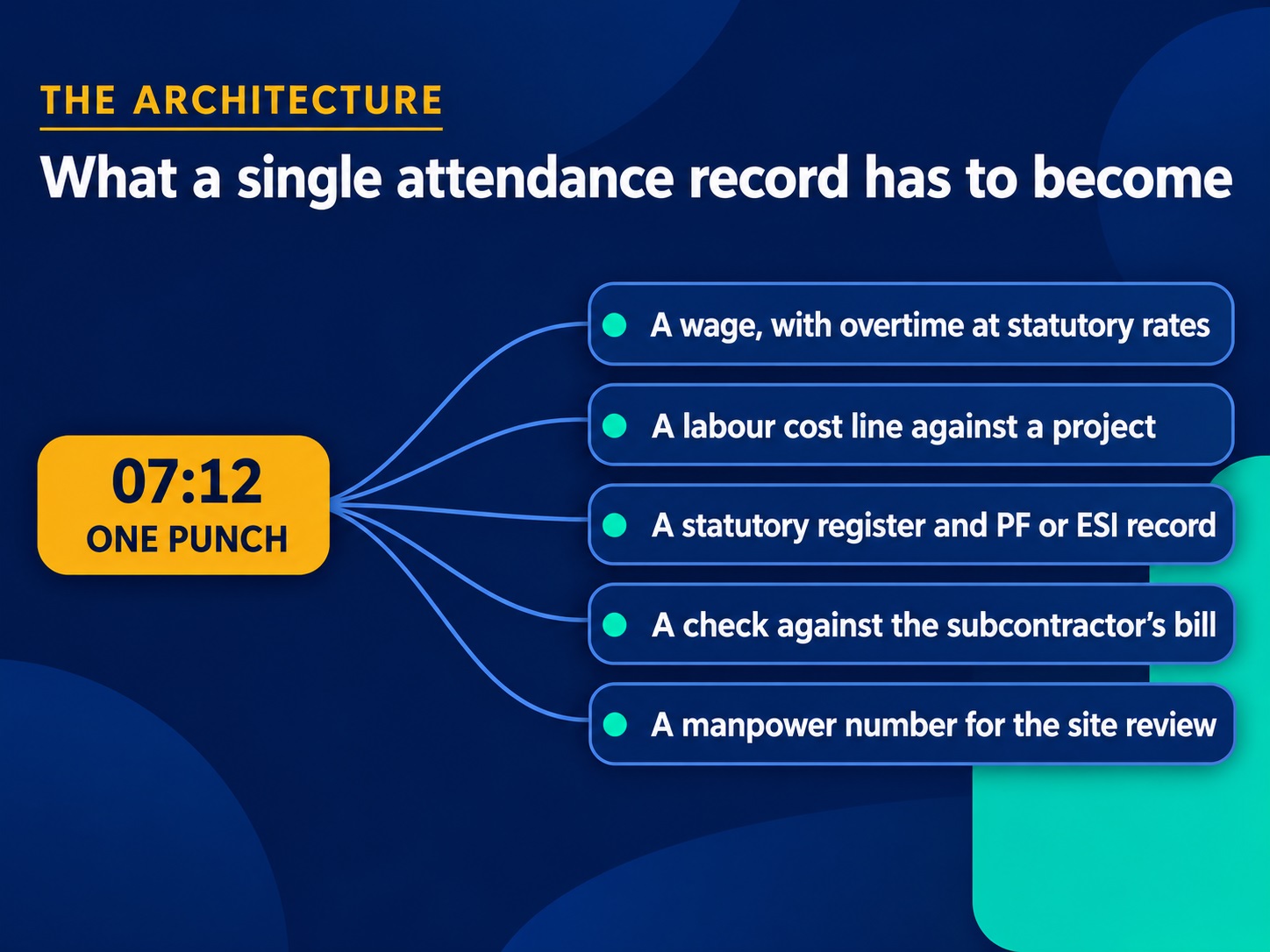
Five outputs. One input. That is the entire case for a single HR system in construction, and it is what separates capable HR software for construction companies in India from a generic platform with a site module bolted on.
If those five outputs live in five different tools, you have not bought flexibility. You have bought five versions of Tuesday morning, plus the staff required to argue about which one is correct. Every additional system multiplies reconciliation work rather than adding capability.
Run them from one record and something quietly changes. The subcontractor’s bill can be checked against attendance before it is paid rather than after. Project labour cost updates on the day, not in ten days. And when an inspector asks for the wage register, it is generated from the same data that produced the wages.
Field staff tracking software in India and the multi-site problem
Construction adds a dimension most workforce software never anticipates, which is that the workplace itself keeps moving.
Sites open and close. A project in Bhiwandi finishes and forty people shift to a job outside Nagpur. Supervisors travel between work fronts through the day. Engineers split their week across three locations. None of this fits a system that assumes a fixed office with a fixed network.
This is where field staff tracking software in India becomes a genuine requirement rather than a category name. Practically, it means geo-fenced attendance tied to a specific site boundary, a mobile app a supervisor can use one-handed in the sun, offline capture with later sync, and the ability to stand up a new site in the system in an afternoon rather than a fortnight.
It also means labour costs map to projects and milestones instead of just to departments. A project manager does not care what the Mumbai region spent. They care what this floor, this pour, this package cost, and whether it matched the estimate.
The subcontractor layer, where the real risk sits
On most large Indian sites, the majority of people present do not work for you directly. They work for a subcontractor, sometimes for a subcontractor’s subcontractor. Your legal exposure does not respect that distinction.
As the principal employer, you carry responsibility if a contractor fails to pay minimum wages or deposit provident fund and ESI. Which means the question you need answered every month is uncomfortably specific: did this contractor actually pay these particular workers, and can you produce the evidence?
The labour codes have reorganised this considerably. All four came into force on 21 November 2025, consolidating 29 laws including the Contract Labour Act, the Inter-State Migrant Workmen Act and the BOCW Act, with the final central rules notified on 8 May 2026. A single registration now covers your establishment, your contractors, contract workers, inter-state migrants and construction work together. Appointment letters are mandatory for every worker, contract staff included. Construction work with 250 or more workers requires a safety committee. And as of May 2026, more than thirty states and union territories had notified rules for at least one code, though coverage remains uneven.
There is a familiar scenario worth avoiding. An inspector arrives unannounced at a site and asks for four things: the wage register, the muster roll, provident fund contribution records and the welfare registration certificate. At a company running paper registers on site and payroll from a head office several hundred kilometres away, none of the four is immediately available. Nothing improper has happened. The records simply cannot be assembled fast enough to prove it.
Payroll, cess and compliance across 5,000 people
Month-end is where every earlier decision turns into money and legal exposure at the same time.
The variables stack up quickly. Multi-state minimum wages, because a company running sites in four states is working to four different wage schedules. Overtime at twice wages under the codes, with part-hour rounding and a monthly-paid worker’s daily wage calculated as one twenty-sixth. The revised wage definition, where allowances above half of total remuneration count as wages for provident fund and gratuity. Deductions for accommodation, canteen and advances. Contractor invoices that must reconcile against attendance you captured at a gate at 7:12 in the morning.
Then there is the BOCW welfare cess, a 1% levy on construction cost excluding land and wages. Under the Code on Social Security, the older cess legislation has been subsumed, and employers can now self-assess and pay the liability rather than waiting for an assessment. Self-assessment is simpler, but it also moves the burden of getting the number right onto you.
None of this is unmanageable. It is simply not survivable on spreadsheets at five thousand people, because the failure mode is not one big mistake. It is two hundred small ones that nobody notices until an audit or a wage dispute.
What the head office finally sees across every site
When the plumbing works, the reporting stops being an exercise in archaeology.
A regional director can open a view showing manpower deployed against manpower planned, by site and by contractor, for yesterday. A project manager can see labour cost against a milestone while there is still time to act on it. A compliance head can see which contractors are current on statutory payments and which are not, before invoices are released rather than after.
It is worth noting that this architecture is not unique to construction. The same requirements drive HR software for manufacturing in India, where plants replace sites and production lines replace work fronts, and companies running both often discover they need one platform rather than two.
The one-system checklist for construction HR software
If you are evaluating HR software for construction companies in India at this scale, the list is specific and fairly short.
What one HR system has to do at 5,000+ workers:
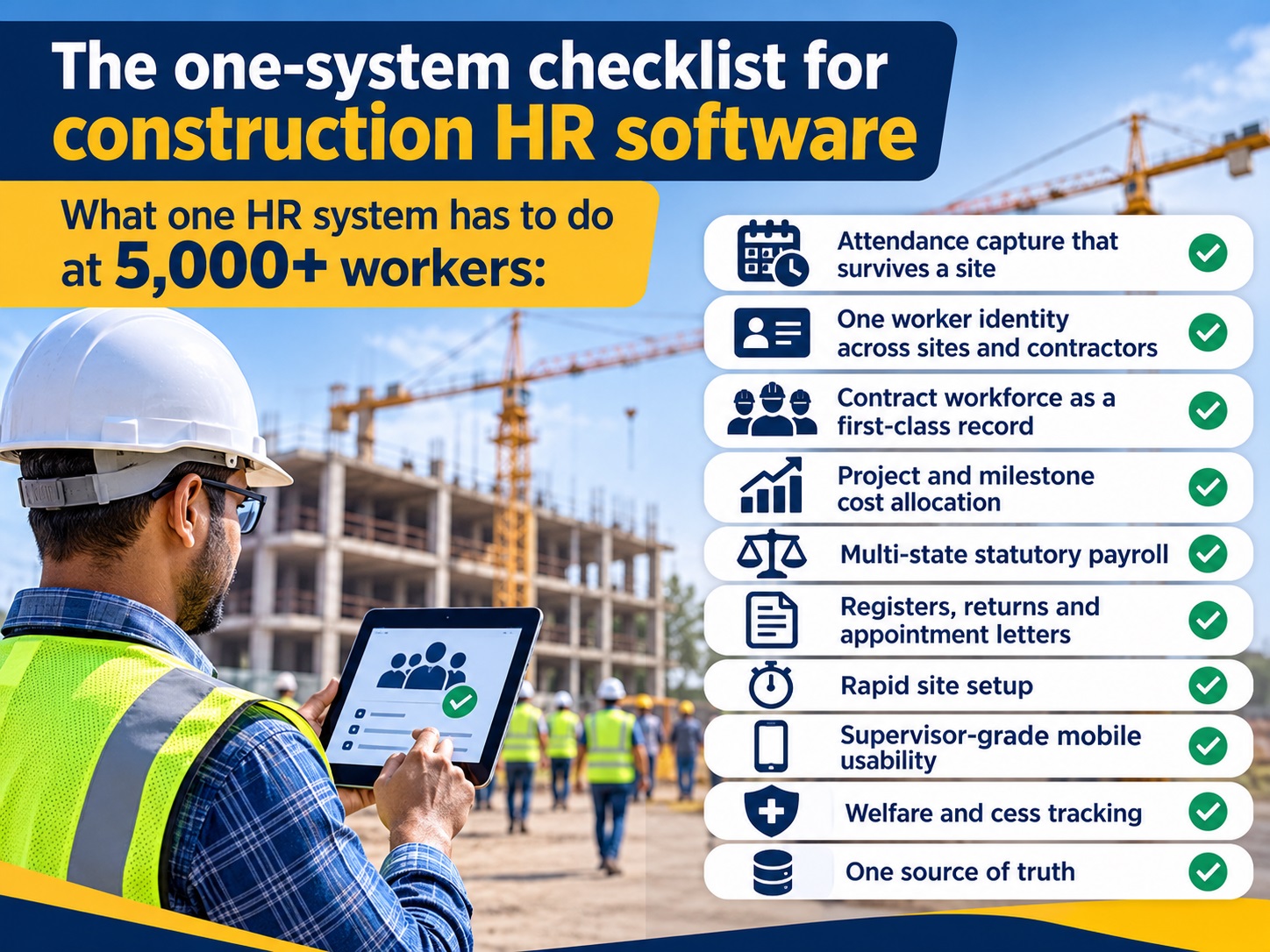
- Attendance capture that survives a site, combining face or card at the gate with mobile geo-tagged capture, and working offline when the network drops.
- One worker identity across sites and contractors, carrying skills, safety training and history rather than starting fresh at each project.
- Contract workforce as a first-class record, linked to contractor and work order, with a monthly compliance trail you can produce on demand.
- Project and milestone cost allocation, so labour cost answers a project question rather than only a departmental one.
- Multi-state statutory payroll, covering overtime multiples, rounding rules, the revised wage definition and state-wise minimum wages.
- Registers, returns and appointment letters generated from the same data that produced the payroll.
- Rapid site setup, so a new project is operational in the system within days of opening.
- Supervisor-grade mobile usability, designed for a phone in bright sunlight rather than a desktop in an office.
- Welfare and cess tracking, including BOCW registration status and self-assessed cess liability.
- One source of truth, so attendance, payroll, compliance and project cost cannot disagree with each other.
What this looks like in practice
Consider a mid-sized infrastructure contractor with about 4,200 workers across nineteen sites in three states, of whom roughly two-thirds sat on subcontractor rolls.
Before, each site kept its own register, payroll ran from head office, and month-end close took eleven working days. Nobody could say with confidence which contractor had deposited provident fund for which month without an exchange of emails. Two people worked essentially full time on reconciliation.
The change was not dramatic in concept. Face capture at the main gates, mobile geo-tagged attendance for scattered work fronts, contract workers held against their contractor and work order, and payroll drawing from the same attendance data rather than from re-keyed sheets.
Within two quarters, month-end close came down to three days. Contractor bills started being checked against attendance before payment rather than after, which surfaced a modest but consistent gap between billed and recorded manpower. And when a labour inspection arrived at one of the Maharashtra sites, the wage register, muster roll and contribution records were produced the same morning. That last outcome is unglamorous, and it is the one the managing director mentioned first.
BUILT FOR SITES, NOT OFFICESOne record. Every destination.Timelabs is built for distributed Indian workforces: biometric and face-based attendance at the gate, geo-tagged mobile capture for field and site teams, contract workforce tracking, and payroll with statutory compliance built in. One system from the 7:12 punch to the project cost report and the wage register. Explore the Timelabs HRMS → timelabs.in |
The bottom line: fewer systems, not more staff
Go back to that pause at the start, the one that follows a simple question asked across forty-one sites.
Closing it is not really a technology achievement. It is an architectural decision made once, that the same fact will be recorded a single time and used in five places, rather than recorded five times and reconciled forever.
This is ultimately what good HR software for construction companies in India is for. Everything the large contractors do well follows from that one choice. They are not better at chasing supervisors for registers. They removed the need to chase. The wage is right on the 7th because the attendance was right on the 12th minute of the 7th hour of a Tuesday, and nothing had to be retyped in between.
Five thousand workers is a big number. It is only an unmanageable one if you are managing it five separate times.
Must Read: HRMS for Manufacturing in India: Why Generic HR Software Fails on the Factory Floor
FAQs: HR software for construction companies in India
Q1: How do large construction companies in India manage 5,000+ workers?
A: By reducing systems rather than adding staff. The workable pattern is a single HR system where one attendance record feeds wages, project cost, statutory registers, subcontractor bill verification and manpower reporting. That removes the reconciliation work that otherwise grows with every site and contractor layer, and it is why large contractors often run leaner HR teams than mid-sized ones.
Q2: What is the best attendance management method for construction sites?
A: A combination usually beats any single device. Face-based capture at the main gate handles volume and works where fingerprints fail, since construction workers’ hands are frequently worn or coated with cement and grease. Mobile geo-tagged attendance covers scattered work fronts and supervisors moving between them. Offline capture with later sync is essential, because site connectivity is unreliable.
Q3: How does field staff tracking software in India work for multi-site projects?
A: It ties attendance to a geo-fenced site boundary through a mobile app, stores records locally when there is no network, and syncs when connectivity returns. Good systems also map labour cost to projects and milestones rather than only to departments, let you set up a new site quickly, and transfer workers between projects instead of re-registering them each time.
Q4: What are the compliance requirements for construction workers under the new labour codes?
A: All four labour codes came into force on 21 November 2025, consolidating 29 laws including the BOCW Act, Contract Labour Act and Inter-State Migrant Workmen Act, with central rules notified on 8 May 2026. A single registration now covers the establishment, contractors, contract workers, migrants and construction work. Appointment letters are mandatory for all workers; construction work with 250 or more workers needs a safety committee, and the 1% BOCW welfare cess continues under the Code on Social Security, with employers able to self-assess. State rules vary, so verify the position in each state where you operate.
Q5: Who is liable if a subcontractor fails to pay workers or deposit PF?
A: As the principal employer, the exposure comes back to you. That is why contract workers should sit in your system as their own record type, linked to a contractor and work order, with monthly evidence that wages were paid and statutory contributions deposited. Checking compliance status before releasing a contractor’s bill is far easier than reconstructing proof during an inspection.
Q6: Can the same system work for both construction sites and factories?
A: Usually yes, because the underlying requirements overlap heavily. HR software for manufacturing in India needs the same gate-speed attendance, shift handling, contract workforce tracking and multi-state statutory payroll, with plants in place of sites. Companies running both types of operations often consolidate onto one platform rather than maintaining separate systems.